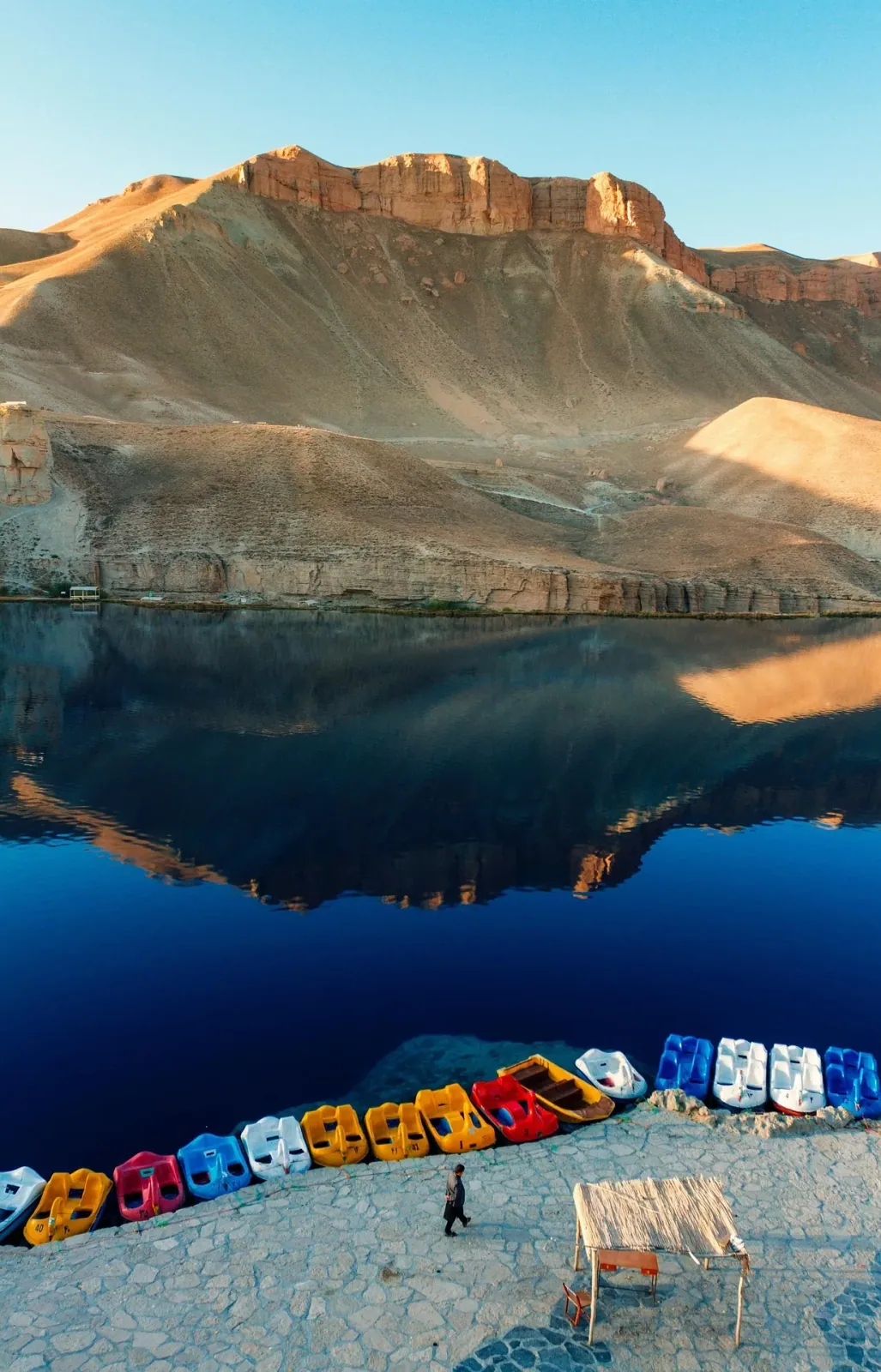
The question arrives before anything else. Before the dates, before the budget, before anyone has looked at a photograph of Band-e-Amir. Someone tells a friend they are thinking of going to Afghanistan, and the friend says: are you mad?
It is a fair question and it deserves a straight answer rather than a brochure one.
Is Afghanistan safe to visit in 2026?
It is far more stable than its reputation, and it is not risk-free. Both of those are true, and any operator who tells you only the first half is selling you something.
What has changed is measurable. International visitor numbers went from 691 in 2021 to roughly 9,000 in 2024, and estimates for 2025 put it somewhere between 7,000 and 12,000. The twenty-year war that shaped everyone's mental image of this country is over. The front lines, the checkpoints changing hands, the daily fighting — that is not the Afghanistan you would be travelling through.
What has not changed is that the United States, United Kingdom, Canada and Australia all still place Afghanistan at their highest advisory level: do not travel. That has real consequences, and we will come to them.
What is the actual risk?
Not the Taliban administration, which wants tourism and treats foreign visitors as guests. The named threat is ISIS-K, a group hostile to the Taliban and to foreigners alike, responsible for the attacks that do occur.
The honest framing is this: the risk is low-probability and high-consequence. It is not the kind of risk you manage by being careful crossing the road. It is managed by where you go, when you move, and who is making those decisions for you.
This is precisely why almost nobody visits Afghanistan independently any more. Not because it is forbidden, but because the single biggest safety variable is local knowledge that updates daily — and you cannot buy that from a guidebook.
Where is safest?
Bamyan is consistently the safest province in the country for international visitors, and it happens to hold the things most people come for: the Buddha niches, Band-e-Amir National Park, the ruins of Shahr-e Gholghola. UN monitoring records a handful of security incidents a year in the central valley and tourist corridors.
The regions we operate in — Kabul, Bamyan, Mazar-e-Sharif, Herat, and the Wakhan — are the most settled parts of the country. That is not a coincidence. It is the reason those are the routes.
There are provinces we do not take visitors to. If you ask us for one of them, we will say no and explain why. An operator who agrees to everything is not an operator you want.
What "do not travel" actually means for you
This is the part most articles skip, and it matters more than the abstract risk:
- Your travel insurance is probably void. Most standard policies exclude countries under a do-not-travel advisory. You need specialist cover, bought deliberately, before you fly.
- There is no consular help. Most Western embassies in Kabul are closed. If something goes wrong, your government very likely cannot reach you.
- Medical evacuation is expensive and slow. Factor it into your insurance rather than hoping.
None of this is a reason not to come. It is a reason to come prepared, and to be honest with yourself and the people at home about what you are choosing.
How a guided trip actually reduces the risk
The value is not a man in a vehicle. It is the decisions made before you arrive and the ones made hourly while you are there.
- Conditions are read daily, not monthly. Guides talk to people along the route. A road that was fine last week and is not fine today gets swapped out before you notice there was a choice.
- Paperwork is done properly. Most trouble travellers get into in Afghanistan is administrative, not violent — a missing permit, an unstamped passport. The permits guide covers why.
- Accommodation is inspected, not booked from a listing.
- Someone always knows where you are. That sounds small until it matters.
What travellers actually report
Almost universally, that the gap between expectation and reality was enormous — and in the direction nobody predicted.
Tea pressed on them by shopkeepers who would not take money. Checkpoint guards asking where they were from and grinning. Families inviting them to eat. The recurring sentence, in trip report after trip report, is some version of: I have never been made to feel so welcome anywhere.
Afghans are acutely aware of how their country is seen, and genuinely moved that someone chose to come. That shows up constantly, in small ways, all day.
So should you go?
If you want certainty, no country under a do-not-travel advisory will give it to you, and you should choose somewhere else without embarrassment.
If you can accept a small, real, well-managed risk in exchange for one of the last genuinely unvisited places on earth — mountains almost nobody has walked, cities older than most countries, and hospitality that will recalibrate what you thought that word meant — then yes. Go with a licensed operator, go with proper insurance, and go with your eyes open.
Have a look at where we actually go, or ask us anything you are still uneasy about. We would rather talk you through a hard question than have you book on a half-answer.
Conditions change. Everything here reflects the position as of August 2026 — check the current picture with us before you commit to flights.