The commonest mistake people make planning Afghanistan is trying to see all of it.
They arrive with a list — Bamyan, Herat, Mazar, the Wakhan, Jam — and ten days. Then they spend seven of those days in a vehicle, watching the country they came for go past a window, and leave with photographs of everything and a memory of nothing.
The distances are large, the roads are slow, and the good part is always the part you stayed long enough for.
How long do you need in Afghanistan?
One week covers Kabul and Bamyan comfortably. Two weeks adds Mazar-e-Sharif and Herat along the northern Silk Road. Three weeks or more is what the Wakhan, Nuristan or the Minaret of Jam actually require.
Those are not marketing numbers. They are what fits without the trip becoming a driving holiday.
One week — Kabul and the Central Highlands
The right first trip, and the one we would push most people towards.
Kabul, two days. Bagh-e Babur, where the first Mughal emperor chose to be buried, terraced above the city. The Ka Farushi bird market — a narrow lane of cages and whistling and haggling that is the most alive corner of Afghanistan. Darulaman Palace, restored after decades as a shell.
Bamyan, three days. The road climbs for hours and then the valley opens and there are the empty Buddha niches, holding the shape of what stood in them for fifteen centuries. Above the valley, Shahr-e Gholghola — the City of Screams, sacked by Genghis Khan — and the red mud-brick fortress of Shahr-e Zuhak on its ridge.
Band-e-Amir, one full day. Six lakes held back by natural travertine dams, a blue that photographs are routinely accused of faking. Afghanistan's first national park. Go early; take the boat.
Our Central Highlands Classic runs 4–8 days and covers exactly this, from $699 per person. Valleys & Bamyan Discovery is 5–6 days and adds the Panjshir Valley on the way in.
Two weeks — adding the north and west
Everything above, plus the two cities that make Afghanistan make sense historically.
Mazar-e-Sharif, two days. Built around the Blue Mosque — the Shrine of Hazrat Ali — tiled in a dozen blues, surrounded by white marble and thousands of white pigeons. The best ice cream in the country. In winter, Friday buzkashi.
Balkh, half a day, twenty kilometres away and four thousand years old. One of the oldest continuously inhabited places on earth, the birthplace of Rumi, with city walls you can walk and a Buddhist stupa older than Islam in the region.
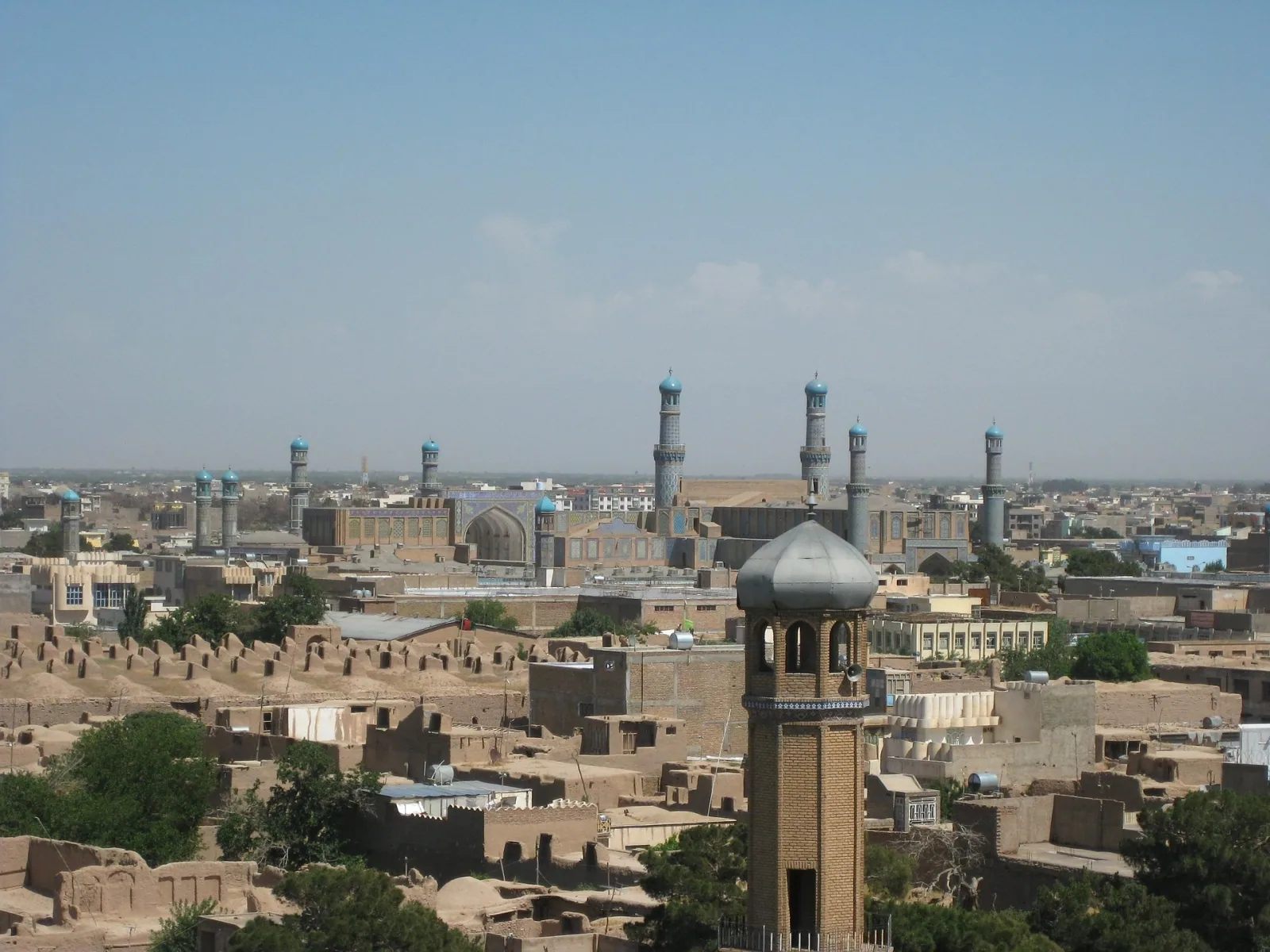
Herat, two to three days. The most Persian city in Afghanistan and the richest in surviving architecture. The Citadel traces to Alexander's campaign in 330 BC. The thirteenth-century Friday Mosque still has a working tile workshop attached, where mosaics are cut by hand exactly as they always were. The minarets stand out on the plain, leaning, improbable.
Take the domestic flights. Kabul–Mazar and Kabul–Herat are cheap and save you entire days. On a two-week trip that is the difference between three cities properly and five cities badly.
The Silk Road North Circuit is 6–8 days from $999. Heritage South–West Grand Circuit is 8–10 days from $1,799.
Three weeks or more — the parts almost nobody sees
This is where Afghanistan stops being a destination and becomes something else.
The Wakhan Corridor. A finger of land where the Hindu Kush meets the Pamirs, which the last forty years largely passed by. Perhaps 150 to 200 visitors a year. High passes, hot springs, Wakhi villages, and the nomadic Kyrgyz of the Little Pamir. The finest trekking in the country, and it is not close. Needs 10–14 days on its own — our Roof of the World Expedition, from $2,299.
The Minaret of Jam. Sixty-three metres of twelfth-century brickwork alone in a river valley in Ghor, the world's second-tallest free-standing minaret, a UNESCO site, two hundred kilometres down genuinely bad road. Say early if this is your reason for coming — it takes planning.
Nuristan. Dense alpine forest and timber houses stacked up steep valleys. It looks like nowhere else in the country. The Emerald East Loop covers it in 7–9 days from $1,299.
Everything, end to end, is the Grand National Highlights — 24 days, east, north, south and west, from $2,899.
Have a day spare in Kabul?
Istalif, a village on a green hillside north of the city, known for generations of turquoise-glazed pottery you can watch being thrown. Or Paghman, the old summer retreat to the north-west — cool air, mountain water, rock pools fed by snowmelt.
When to go
Spring (April–June) and autumn (September–November) are the windows: clear skies, comfortable temperatures, roads open.
The Wakhan is the exception — July to September, once the passes are reliably clear. Summer is hot in Kabul and the lowlands but pleasant in the highlands. Winter brings snow that closes mountain roads to Bamyan, though it also brings skiing there, and buzkashi in the north.
Three things worth planning around
- Build in slack. Roads close, weather turns, paperwork takes an afternoon. A schedule with no give becomes a schedule that breaks.
- Provincial permits gate everything. Each province needs its own stamped permission, and that shapes what is realistic. How that works.
- Fewer places, longer stays. Every returning traveller says the same thing. The afternoon you did not rush is the one you remember.
Compare the itineraries, or tell us how long you have and what you actually care about — and we will build the trip backwards from that instead of selling you a route.